
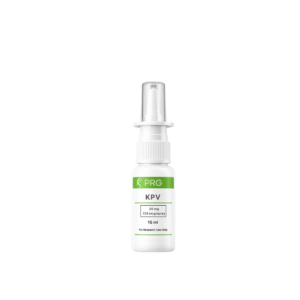
KPV 10mg: What the Research Actually Shows
KPV is a small but heavily discussed tripeptide in inflammation and gut-barrier research. If you’re comparing KPV 10mg listings, it’s worth understanding what’s actually been studied before you look at suppliers, because a lot of what circulates online overstates the evidence considerably.
Research use only. KPV is sold for laboratory research. It is not a medicine, supplement or food, and it is not intended for human or veterinary use. No human dosing protocol has been established for this compound.
What Is KPV?
KPV (lysine-proline-valine) is a three-amino-acid fragment cut from the tail end of alpha-melanocyte-stimulating hormone (alpha-MSH), specifically positions 11-13 of the parent hormone. Because it’s isolated from the pigmentation-driving part of alpha-MSH, researchers use it to study the hormone’s anti-inflammatory signalling separately, without the melanocortin-receptor activity that causes tanning.
Key identifiers:
- Sequence: Lys-Pro-Val (K-P-V)
- Molecular formula: C16H30N4O4
- Molecular weight: 342.43 g/mol
- Receptor behaviour: studied as melanocortin-receptor-independent
- Form: lyophilised powder, typically ≥99% purity
What the Research Investigates
Published KPV research sits almost entirely at the preclinical stage; cell cultures and animal models, not human trials. The main lines of investigation include:
- Inflammatory signalling. Studies report that very low concentrations of KPV block NF-kB and MAP kinase activity in cultured cells, reducing release of inflammatory messenger proteins.
- Gut barrier research. The foundational 2008 study (Dalmasso et al., Gastroenterology) found KPV enters cells via a transporter called PepT1, which the gut produces more of during inflammation, and tested the effect in two mouse colitis models (DSS and TNBS).
- Receptor-independence. Follow-up work in mice bred without melanocortin receptors confirmed KPV’s effect doesn’t rely on the same receptor pathway as alpha-MSH, which is also why it doesn’t cause pigmentation.
- Skin-cell research. More recent lab work has examined KPV’s effect on oxidative stress and inflammatory signalling in human skin cells exposed to fine particulate matter.
The researchers behind the original work were notably careful with their own language, concluding KPV “might be” a useful direction for further study, not that it treats anything. That distinction matters: a pathway blocked in a petri dish is a research finding, not a health outcome, and it hasn’t been shown to translate to people.
Buy KPV 10mg: What to Check Before You Order
If you’re planning to buy KPV 10mg for laboratory work, check for:
- Batch-specific COA confirming purity (≥99% by HPLC is a reasonable benchmark) and identity via mass spectrometry
- Sequence confirmation matching Lys-Pro-Val, distinct from full-length alpha-MSH or other melanocortin fragments
- Third-party testing, ideally across independent ISO-accredited laboratories rather than in-house only
- Clear research-use labelling, with no dosing instructions, health claims, or human-use framing anywhere on the page
- Cold-chain storage guidance — typically refrigerated at 2-8°C, protected from heat, moisture and direct light
KPV 10mg Dosage: Why No Answer Exists
Searches for KPV 10mg dosage are common, but the honest answer is that no established human dosing protocol exists for KPV, and no reputable source should provide one. Published studies report exposure levels chosen to answer specific lab questions; nanomolar concentrations in cell culture, or a stated microgram-per-millilitre concentration in a skin-cell assay, for example, and these figures don’t convert into a human quantity, schedule or route. They describe conditions in a dish or an animal model, not instructions for a person.
Any site providing specific mcg amounts, syringe-unit charts or injection schedules for KPV is presenting community-sourced, self-experimentation content as if it were established science. It isn’t, and treating it as such carries real safety risk given there’s no completed human safety data for this compound.
If you’re a laboratory researcher working with KPV in an in-vitro or animal-model context, your concentration and exposure parameters should come from your own study design and institutional protocols, cross-referenced against the published literature relevant to your specific model, not from a generic online chart.
Regulatory Status
KPV has no approved medicinal status. In the US, it was placed in a Category 2 classification under Section 503A in 2023, reflecting unresolved safety questions, and an FDA advisory committee later voted on whether to recommend it for pharmacy compounding — a non-binding recommendation, distinct from drug approval. Regulatory status can and does change, so check current guidance (MHRA in the UK, FDA in the US) rather than relying on a fixed statement.
Supplier Comparison Checklist
| Factor | Strong supplier | Warning signs |
|---|---|---|
| Testing | Batch COA, independent lab verification | No documentation, or single in-house test |
| Claims | Research-use wording, preclinical framing | “Anti-inflammatory,” “gut health support,” dosing charts |
| Sequence data | Clearly stated (Lys-Pro-Val) | Vague or generic |
| Regulatory framing | Accurate, sourced, up to date | Overstated or invented approval status |
| Storage | Refrigerated, clear handling instructions | No storage guidance |
Storage and Handling
- Store lyophilised powder as directed on the COA, typically refrigerated and protected from heat, light and moisture
- Once reconstituted, storage conditions vary by formulation, follow the specific product documentation rather than a generic figure
- Avoid repeated freeze-thaw cycles
- Discard any reconstituted solution that appears cloudy or shows particulates
Frequently Asked Questions
Does KPV cause tanning like other alpha-MSH-derived peptides?
No. Research indicates KPV’s effect is independent of the melanocortin receptors responsible for pigmentation, unlike full-length alpha-MSH or melanotan compounds.
Is there a proven human dose for KPV?
No. All available data comes from cell culture and animal studies. No completed human dose-finding trial exists.
Is KPV approved by the FDA or MHRA?
No. It has no approved medicinal status, and current regulatory discussion (in the US) concerns pharmacy compounding classification, not drug approval.
What should I check before buying a research vial?
A batch-specific COA with independent purity and identity verification, and clear “research use only” labelling with no dosing or health claims.
Final Thoughts
KPV has a genuinely interesting research story, particularly around PepT1-mediated gut uptake, but the evidence is entirely preclinical. Choose a supplier that represents that honestly: verified purity, transparent documentation, and no pretence at a human dosing protocol that doesn’t exist.
Reviews
There are no reviews yet.