
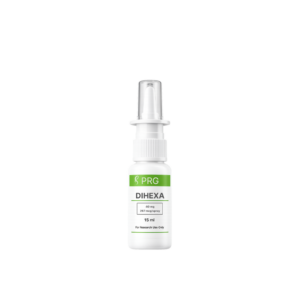
What Is the Dihexa Peptide?
The Dihexa peptide is one of the more unusual entries in the research compound space, because it isn’t a traditional amino-acid chain at all. Despite the “peptide” label commonly attached to it, Dihexa is more precisely described as a peptidomimetic: a small molecule engineered to mimic part of a much larger natural peptide’s activity, in this case, a fragment of angiotensin IV.
Key identifiers:
- Structural shorthand: Hexanoyl-Tyr-Ile-Ahx-NH2
- Structural components: an N-terminal hexanoyl group, L-tyrosine, L-isoleucine, and a 6-aminohexanamide component
- CAS number: 1401708-83-5
- PubChem CID: 129010512
- Molecular formula: C27H44N4O5
- Average molecular weight: approximately 504.67 g/mol
- Alternative names: PNB-0408, N-hexanoyl-Tyr-Ile-(6-aminohexanoic amide)
Research use only. Dihexa is sold for laboratory research and analytical work. It is not a medicine, supplement or food, and it is not intended for human or veterinary use.
The Research Behind Dihexa
Dihexa was developed by researchers at Washington State University, building on earlier work into angiotensin IV analogues and their effect on hepatocyte growth factor (HGF) and its receptor, c-Met. The scientific interest centres on Dihexa’s investigated ability to cross the blood-brain barrier while retaining activity at neurotrophic signalling pathways associated with synaptogenesis, the formation of new synaptic connections between neurons.
Published research on Dihexa is preclinical: cell-based and animal-model studies examining its interaction with the HGF/c-Met pathway and downstream effects on neuronal connectivity. This is a genuinely active and specific area of neuroscience research, but it’s worth being precise about the current evidence: no completed human clinical trial has established safety, efficacy, or an appropriate dose for Dihexa in people. Findings from cell cultures and animal models describe a mechanism worth studying further; they don’t constitute evidence of an effect in humans.
Dihexa Peptide in UK: What to Check Before You Buy
If you’re sourcing the Dihexa peptide in UK for laboratory work, documentation matters considerably more here than for a well-established amino-acid peptide, given Dihexa’s more complex synthetic structure. Check for:
- Batch-specific Certificate of Analysis (COA) confirming chromatographic purity (≥99% is a reasonable current benchmark) via the stated analytical method
- Mass spectrometry identity confirmation, consistent with the specified molecular structure and stereochemistry, not just the tyrosine-isoleucine core
- Safety Data Sheet (SDS) available alongside the COA
- Clear distinction between chromatographic purity and net material content, since water content and residual solvents affect the two differently
- Research-only labelling, explicitly excluding human, animal, clinical, diagnostic or therapeutic use, and referencing MHRA compliance
Dihexa Peptide 20mg: Specification Checklist
A Dihexa peptide 20mg listing should give you enough detail to independently verify what you’re buying, not just a headline weight and price. Look for a specification table covering:
| Specification | What a credible listing should state |
|---|---|
| Structure | Hexanoyl-Tyr-Ile-Ahx-NH2, with stereochemistry noted |
| CAS number | 1401708-83-5 |
| Purity | ≥99% chromatographic purity, method specified |
| Identity | Mass spectrometry consistent with the full structure |
| Physical form | Laboratory powder or lyophilised material, per batch COA |
| Documentation | Batch-specific COA and SDS, linked directly on the product page |
| Labelling | “Research use only,” explicit exclusion of human/animal/clinical use |
Because Dihexa is synthesised differently from a standard peptide chain, a supplier that simply reuses templated peptide-listing language, without addressing its distinct chemical classification, is a signal to look more closely at their documentation before ordering.
Dihexa Peptide Dosage: Why No Protocol Exists
Searches for Dihexa peptide dosage are common, but there’s an important gap to be honest about: no completed human dose-finding trial exists for Dihexa, and no responsible source should present a specific human dosing figure as established fact. The exposure levels reported in the published literature are animal-model amounts, chosen by researchers to answer specific questions about the HGF/c-Met pathway in a particular species, under particular experimental conditions. They don’t translate into a human quantity, and there is no clinical safety data to support treating any converted figure as reliable.
If you’re a researcher working with Dihexa in a cell-culture or animal-model context, your exposure parameters should be drawn from your own study design and the specific primary literature relevant to your model, in line with your institution’s protocols, not from a generic dosing chart intended for self-administration.
Storage and Handling
- Store as directed on the applicable COA or SDS; laboratory powder or lyophilised material is typically kept cool, dry and protected from light
- Follow the specific solvent, concentration and handling procedure stated in your batch documentation when dissolution is required, rather than a generic instruction
- A credible research supplier will state plainly that it doesn’t provide dosage, administration or human/animal use advice
- Avoid repeated freeze-thaw cycles once in solution
Supplier Comparison at a Glance
| Factor | Strong supplier | Warning signs |
|---|---|---|
| Documentation | Batch-specific COA + SDS, linked per product | No documentation, or generic reused PDFs |
| Structural detail | Full structure, CAS number, stereochemistry noted | Vague “peptide” description with no chemical specificity |
| Purity reporting | Chromatographic purity and net content shown separately | Single unexplained “purity” figure |
| Claims | Explicit “no dosage advice,” MHRA-compliance language | Cognitive-enhancement or dosing claims |
| Business | UK company number, address, phone support | Anonymous storefront |
Frequently Asked Questions
Is Dihexa really a “peptide”?
Not in the strict sense. It’s a peptidomimetic, an engineered small molecule built around a tyrosine-isoleucine core with an added hexanoyl group and aminohexanamide component, designed to mimic part of a natural peptide’s activity rather than being a straightforward amino-acid chain itself.
Is there a proven human dose for Dihexa?
No. Available data comes from animal and cell-based studies. No completed human dose-finding trial has established a dose, schedule or administration route.
Is Dihexa approved as a medicine in the UK?
No. It has no MHRA-approved medicinal status and is sold strictly for laboratory research.
What should I check before buying a 20mg vial?
A batch-specific COA with chromatographic purity and mass-spectrometry identity confirmation, a correctly stated structure and CAS number, and explicit research-only labelling with no dosing content.
Final Thoughts
Dihexa sits at an interesting intersection of neuroscience research and synthetic chemistry, and its more complex structure means documentation quality matters even more than usual. Choose a supplier that treats that complexity seriously: full structural and analytical detail, verified purity and identity, and no invented human dosing protocol.
Reviews
There are no reviews yet.