
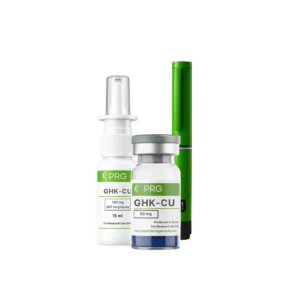
GHK-Cu 50mg: What You’re Actually Buying
GHK-Cu 50mg is one of the most searched vial sizes for this copper-binding tripeptide, widely used across skin, collagen and tissue-remodelling research. Before comparing suppliers on price, it’s worth understanding what’s actually been studied, and being clear-eyed about the gap between that research and the “dosing protocol” content that circulates around this compound.
Research use only. GHK-Cu is sold for laboratory research. It is not a medicine, supplement or food, and it is not intended for human or veterinary use. No approved human dosing protocol exists for this compound.
What Is GHK-Cu?
GHK-Cu, glycyl-L-histidyl-L-lysine copper(II), is a naturally occurring human plasma tripeptide first isolated in 1973. It binds copper with high affinity, and research has examined its role in extracellular matrix regulation, wound-repair signalling and antioxidant pathways. Endogenous plasma GHK levels are documented to decline substantially with age, which is the biological rationale cited across most of the research and provider literature discussing it, though that’s a description of declining natural plasma levels, not a dosing target for anyone taking the compound.
Key identifiers:
- Structure: copper(II) complex of the tripeptide Gly-His-Lys
- Appearance: pale blue lyophilised powder (colour comes from the copper chelate)
- Plasma half-life: reported at roughly 5-30 minutes in the literature
- Storage: -20°C, protected from light, when lyophilised
What the Research Shows — and Doesn’t
Published GHK-Cu research spans cell culture, animal models and mechanistic studies of pathways like TGF-β and VEGF signalling in tissue remodelling. What’s important, and what a lot of provider content glosses over, is that no published, peer-reviewed human subcutaneous trial of GHK-Cu exists as of the current literature. Figures that circulate as “standard research doses” for skin, wound-healing or hair-follicle endpoints are, by the honest account of the sites that publish them, aggregated from animal models, cell-culture data, and unlinked “practitioner protocols,” not clinical trial data. Treat any specific mg/day figure you encounter online with that context in mind.
How to Check GHK-Cu 50mg Quality Before You Buy
- Batch-specific COA confirming both HPLC purity (≥98-99% is the current market standard) and mass spectrometry identity — purity alone doesn’t confirm the vial contains the labelled compound
- Independent, UK-based lab testing, not just a manufacturer’s in-house certificate
- Correct appearance and identifiers — GHK-Cu powder should appear pale blue; discolouration or clumping is a discard signal, not a quality-control detail to overlook
- Clear storage guidance — typically -20°C for lyophilised powder, with a stated shelf life
- Research-only labelling, with no injection technique, dosing schedule, or human-use instructions anywhere on the page
Reconstituting GHK-Cu 50mg: General Concentration Math
Reconstituting GHK-Cu 50mg is a concentration calculation, not a dosing decision. The principle is straightforward: the milligram amount in the vial, divided by the millilitres of diluent added, gives you the resulting concentration in mg/mL. A smaller diluent volume produces a more concentrated solution; a larger volume produces a more dilute one.
Beyond that general principle, the diluent volume, solvent choice and target concentration appropriate for your specific research use depend on your own study protocol and institutional methods, not a single figure that applies universally. Follow the guidance provided with your specific batch, and consult your laboratory’s validated procedures for anything beyond the basic mg/mL calculation. A cloudy or discoloured reconstituted solution (deep blue-green rather than pale blue, or any visible particulate) should be discarded.
GHK-Cu 50mg Dosage: Why This Guide Won’t Give You One
Searches for GHK-Cu 50mg dosage are common, but there’s an important distinction worth making plainly: no completed human trial has established a proven GHK-Cu dose, schedule or administration route. What circulates as dosing charts online is, by the source material’s own admission, extrapolated from animal and cell studies, or drawn from unlinked “practitioner protocols” with no clinical validation behind them.
Any site providing specific milligram-per-day figures, injection-site rotation schedules or syringe-unit conversions for GHK-Cu is presenting unverified, aggregated guidance as though it were an established protocol. It isn’t, and there’s no human safety data to support treating it as one. If you’re a researcher working with GHK-Cu in a cell-culture or animal-model context, your exposure parameters should come from your own study design and published primary literature relevant to that specific model, not from a generic online chart built for self-administration.
Storage and Handling
- Store lyophilised powder at -20°C, protected from light
- Once reconstituted, store refrigerated (2-8°C) and follow the shelf-life guidance specific to your batch and diluent
- Never refreeze a reconstituted solution — freeze-thaw cycling can precipitate the copper-peptide complex, producing visible particulate
- Allow refrigerated solution to reach room temperature before use in cell-based assays, per your own protocol
Supplier Comparison at a Glance
| Factor | Strong supplier | Warning signs |
|---|---|---|
| Testing | Batch COA, HPLC + mass spec, independent UK lab | No documentation, or in-house only |
| Claims | Research-use wording, evidence gaps stated honestly | Specific mg/day “protocols” presented as established |
| Content | Concentration math for lab use | Injection technique, site rotation, syringe-unit self-dosing charts |
| Appearance guidance | Notes correct pale-blue colour, discard criteria | No quality/appearance guidance given |
| Regulatory framing | Accurate, UK-specific | Vague or absent |
Frequently Asked Questions
Is there a proven human dose for GHK-Cu?
No. All available data comes from cell culture, animal models and unlinked practitioner sources. No completed human clinical trial has established a dose, schedule or route.
Why is GHK-Cu powder blue?
The colour comes from the copper(II) chelate. A properly reconstituted solution should be clear with a pale blue tint; deeper discolouration or cloudiness signals degradation or contamination.
Is GHK-Cu approved as a medicine in the UK?
No. It has no MHRA-approved medicinal status and is sold strictly for laboratory research.
What should I check before buying a 50mg vial?
A batch-specific COA with independent purity and identity testing, clear storage guidance, and no injection or dosing instructions on the product page.
Final Thoughts
GHK-Cu has a genuinely interesting research history, but a lot of what’s published online about “dosing” it overstates thin evidence into something resembling a clinical protocol. Choose a supplier that’s honest about that gap: verified purity and identity testing, transparent documentation, and no pretence at a human administration protocol that current science doesn’t support.
Reviews
There are no reviews yet.