
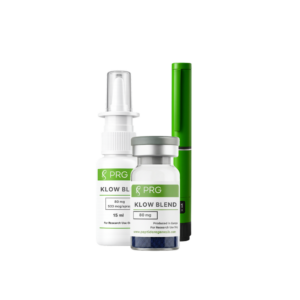
KLOW Blend 80mg: What’s Actually in the Vial
The KLOW Blend 80mg has become one of the most searched multi-peptide research formulations in the UK market, combining four individually well-studied compounds into a single vial. If you’re comparing listings, understanding exactly what’s in the blend, and how suppliers differ on documentation, matters more than the price on the label.
Research use only. KLOW is sold for in-vitro laboratory research. It is not a medicine, supplement or food, and it is not intended for human or veterinary use.
What Is the KLOW Blend?
KLOW is a combination formulation built from four peptides, each studied independently in different areas of cellular and molecular research:
- K — KPV (Lysine-Proline-Valine): studied in inflammatory and gastrointestinal signalling models
- L — L(GHK-Cu) (Glycyl-L-Histidyl-L-Lysine Copper Complex): a copper-binding tripeptide studied in extracellular matrix and skin-related signalling
- O — (o)BPC-157 (Pentadecapeptide BPC-157): a synthetic 15-amino-acid peptide investigated in gastrointestinal mucosal and connective tissue models
- W — (w)TB-500 / Thymosin Beta-4 Fragment: examined in cellular migration and cytoskeletal signalling research
The name is built from the first letter of each component. Across suppliers, the 80mg vial size is standard for this blend, typically split across the four peptides rather than 80mg of each individually, so check exactly how the milligrams are allocated before comparing listings.
BPC 157 TB 500 KPV GHK-Cu 80mg KLOW Blend: Composition Details
If you’re specifically searching BPC 157 TB 500 KPV GHK-Cu 80mg KLOW blend, the point is to confirm which exact compounds and how much of each are in a given vial, since this varies between suppliers:
| Component | Research area | Molecular basis |
|---|---|---|
| GHK-Cu | Extracellular matrix, skin/copper signalling | Copper-binding tripeptide |
| BPC-157 | Gastrointestinal mucosal, connective tissue | 15-amino-acid synthetic peptide |
| TB-500 (Thymosin Beta-4 Fragment) | Cellular migration, cytoskeletal signalling | Synthetic fragment, e.g. Ac-LKKTETQ |
| KPV | Inflammatory, gastrointestinal signalling | Tripeptide (Lys-Pro-Val) |
Each of these has its own individual research literature. Studies of any one component don’t establish how the four behave in combination — evidence on the blend itself is separate from, and thinner than, evidence on the individual peptides. A transparent supplier should be explicit about that distinction rather than implying combined efficacy from single-compound studies.
How to Check Quality Before You Buy
Because KLOW is a blend rather than a single compound, quality verification is more involved than for a standalone peptide:
- Confirm exact composition. The milligram split across all four components should be stated, not just the 80mg total.
- Request the batch-specific COA. Look for both HPLC (purity) and mass spectrometry (identity) testing, since purity alone doesn’t confirm the vial contains what it claims.
- Check testing independence. A COA from an independent UK-based lab carries more weight than a manufacturer’s own certificate, and shouldn’t be reused across batches.
- Verify storage conditions. Lyophilised blends are typically stored at -20°C, with a stated shelf life (commonly around 24 months when stored correctly).
- Confirm research-only labelling, with no dosing instructions, health claims, or human-use framing.
How Much BAC Water for an 80mg KLOW Blend: Reconstitution Basics
How much BAC water for an 80mg KLOW blend is a straightforward concentration question, not a dosing one. Reconstitution volume determines the concentration of your stock solution; it doesn’t tell you what quantity is appropriate for any particular research application, which depends entirely on your own study design.
The general principle: the milligram amount in the vial divided by the millilitres of bacteriostatic water added gives you the resulting concentration (mg/mL). A smaller volume of diluent produces a more concentrated solution; a larger volume produces a more dilute one. Because KLOW combines four peptides at different individual proportions within the 80mg total, the concentration of each component in your final solution depends on that underlying split, not just the total milligrams.
Beyond that general principle, the correct reconstitution volume for your specific research application depends on your study protocol, the compound ratios in the vial you’ve purchased, and your institution’s validated methods; not a single figure that applies universally. Follow the reconstitution guidance provided with your specific batch, and consult your own laboratory protocols for anything beyond the basic mg/mL calculation.
Storage and Handling
- Store lyophilised powder at -20°C, protected from light and moisture
- After reconstitution, store at 2-8°C
- Some suppliers state the reconstituted or frozen solution can be kept for extended periods (up to 2 years when frozen, per some listings), but always follow your specific batch’s documentation rather than a general figure
- Avoid repeated freeze-thaw cycles
Supplier Comparison at a Glance
| Factor | Strong supplier | Warning signs |
|---|---|---|
| Composition | Full mg breakdown of all 4 components | Only the 80mg total stated |
| Testing | HPLC + mass spectrometry, independent UK lab | HPLC only, or no lab named |
| COA | Batch-specific, published per order | Generic or reused across batches |
| Stock | Genuinely available | Frequently “out of stock” with live add-to-cart |
| Claims | Research-use wording, evidence limited to preclinical | Implied combined-effect claims not backed by blend-specific studies |
Frequently Asked Questions
Does research on the individual peptides in KLOW apply to the blend as a whole?
Not directly. Each component has its own separate research literature; how they behave in combination is a distinct question that isn’t automatically answered by single-compound studies.
Is the milligram split the same across all KLOW suppliers?
Not necessarily. Always check the specific breakdown for the vial you’re buying rather than assuming a standard ratio.
What’s the difference between purity testing and identity testing?
HPLC purity confirms how much of the material is the intended compound versus impurities. Mass spectrometry confirms the compound is actually what the label claims. A credible supplier provides both.
Is KLOW approved as a medicine in the UK?
No. It has no approved medicinal status and is sold strictly for in-vitro laboratory research.
Final Thoughts
A KLOW Blend 80mg listing is only as good as its documentation. Confirm the exact composition, request independent batch testing covering both purity and identity, and treat any reconstitution guidance as concentration math for laboratory use, not a personal dosing instruction.
Reviews
There are no reviews yet.