
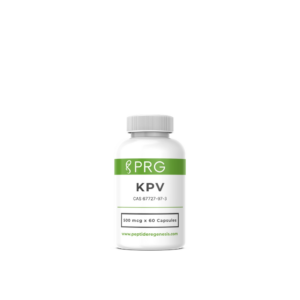
KPV 10mg Peptide: What It Is
The KPV 10mg peptide is a synthetic tripeptide, Lysine-Proline-Valine, derived from a fragment of alpha-melanocyte-stimulating hormone (α-MSH). Researchers study it separately from full-length α-MSH because it retains certain biological signalling characteristics of the parent hormone while behaving independently of the melanocortin receptors responsible for pigmentation.
Key identifiers:
- Sequence: Lys-Pro-Val (K-P-V)
- Molecular formula: C16H30N4O4
- Molecular weight: 342.43 g/mol
- Classification: synthetic tripeptide, α-MSH fragment
- Form: lyophilised powder, typically white to off-white, ≥99% purity
Research use only. KPV is sold for laboratory research. It is not a medicine, supplement or food, and it is not intended for human or veterinary use.
What the Research Actually Shows
KPV research is entirely preclinical, cell cultures and animal models, not human trials. The main areas of investigation:
- Inflammatory signalling. Studies report that low concentrations of KPV inhibit NF-kB and MAP kinase activity in cultured cells, reducing release of inflammatory messenger proteins.
- Gut barrier research. Foundational work (Dalmasso et al., Gastroenterology, 2008) found KPV enters cells via the PepT1 transporter, which the gut upregulates during inflammation, and tested this in two mouse colitis models.
- Receptor-independence. Follow-up studies in mice lacking melanocortin receptors confirmed KPV’s effects don’t depend on the same pathway as full-length α-MSH, which is also why it doesn’t cause pigmentation.
- Broader signalling research. KPV also appears across immunology, tissue biology and general cell-communication studies, reflecting ongoing interest in how short peptide fragments retain biological activity.
The original researchers were careful with their own conclusions, describing KPV as a direction worth further study, not a demonstrated treatment. That distinction is worth preserving in any accurate summary of the evidence.
KPV 10mg Peptide for Sale: What to Check Before You Buy
When comparing KPV 10mg peptide for sale listings, work through this checklist:
- Batch-specific COA, ideally from independent third-party testing, confirming both identity and purity
- Correct sequence and molecular data, matching Lys-Pro-Val and the values above
- Storage guidance appropriate to the product, generally refrigerated on receipt, protected from heat, light and moisture
- Research-only labelling, explicitly excluding human, veterinary, diagnostic or therapeutic use
- No dosage, administration or “protocol” content anywhere on the listing — a supplier that states this outright, rather than quietly omitting it, is the stronger signal
KPV 10mg Peptide in UK: Sourcing Considerations
Buying KPV 10mg peptide in UK from a domestic supplier reduces customs delay risk and keeps the cold chain shorter for a product that’s typically shipped and stored refrigerated. Look for:
- A registered UK company name, number and address
- Independent, third-party batch testing (not just an in-house certificate)
- Clear same-day or next-day dispatch policies
- Explicit terms distinguishing research use from human use, ideally repeated both on the product page and in the site’s terms of sale
KPV 10mg Dosage: Why No Protocol Exists
Searches for KPV 10mg dosage are common, but the accurate answer is that no established human dosing protocol exists for KPV, and no credible research supplier should provide one. The concentrations reported in published studies were chosen to answer specific laboratory questions, nanomolar amounts in cell culture, or a stated dose in a specific mouse model, and these don’t convert into a human quantity or schedule.
The strongest suppliers are explicit about this rather than silent on it: stating plainly that they don’t provide guidance on dosage, administration or expected effects, and that researchers are responsible for their own independent work, is a meaningfully better practice than simply leaving the topic unaddressed, since it closes the door on a buyer assuming an absence of information means there’s a “standard” dose to find elsewhere. If you’re a laboratory researcher, your exposure parameters should come from your own study design and the published literature relevant to your specific model.
Product Specifications Table
| Specification | What a credible listing should state |
|---|---|
| Sequence | Lys-Pro-Val (KPV) |
| Molecular weight | 342.43 g/mol |
| Form | Lyophilised powder, white to off-white |
| Purity | ≥99%, independently batch tested |
| Storage | Refrigerated on receipt, protected from heat/light/moisture |
| Documentation | Batch-specific COA available |
| Labelling | “Research use only,” no dosage guidance provided |
Supplier Comparison at a Glance
| Factor | Strong supplier | Warning signs |
|---|---|---|
| Testing | Independent third-party COA, per batch | No documentation, or in-house only |
| Claims | Research framing, evidence gaps acknowledged | “Gut health support,” “anti-inflammatory” stated as fact |
| Dosage content | Explicitly states none is provided | Specific mg amounts, injection schedules |
| Sequence data | Clearly stated (Lys-Pro-Val) | Vague or generic |
| Business | UK company number, address, contact details | Anonymous storefront |
Frequently Asked Questions
Does KPV cause tanning like other α-MSH-derived compounds?
No. Research indicates KPV’s activity is independent of the melanocortin receptors responsible for pigmentation, unlike full-length α-MSH.
Is there a proven human dose for KPV?
No. All available data comes from cell culture and animal studies. No completed human dose-finding trial exists, and reputable suppliers say so directly.
Is KPV the same as GHK-Cu, BPC-157 or TB-500?
No. These are all distinct compounds with different origins and structures, sometimes grouped together in blend products, but each has its own separate research literature and shouldn’t be treated as interchangeable.
What should I check before buying a 10mg vial?
An independent batch-specific COA, correctly stated sequence and molecular data, and clear confirmation that no dosage or administration guidance is provided.
Final Thoughts
KPV has a genuinely interesting, if early-stage, research story, particularly the PepT1-mediated gut uptake mechanism. Choose a supplier that represents that honestly: independently verified purity, transparent documentation, and no pretence at a dosing protocol that doesn’t exist.
Reviews
There are no reviews yet.