
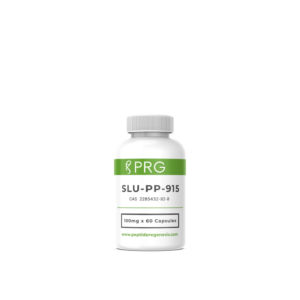
What Is SLU-PP-915?
SLU-PP-915 100mg listings refer to a synthetic small molecule developed as a pan-agonist of the estrogen-related receptors (ERRα, ERRβ and ERRγ). It was designed by researchers based on the ligand-bound crystal structure of ERRγ, using a known agonist scaffold (GSK-4716) as the starting point, and built through a di-substituted thiophene chemistry route distinct from its earlier, related compound, SLU-PP-332.
Key identifiers reported in the primary and supplier literature:
- Receptor target: ERRα, ERRβ, ERRγ (pan-agonist)
- Reported potency: EC50 of approximately 400 nM across all three ERR subtypes
- Route studied: notably, orally active, unlike SLU-PP-332, which has primarily been studied via injection
- Form: solid, research-grade powder
Research use only. SLU-PP-915 is sold for laboratory research. It is not a medicine, supplement or food, and it is not intended for human or veterinary use.
SLU-PP-915 vs SLU-PP-332: Why the Distinction Matters
Because SLU-PP-332 is considerably better known and more widely sold, marketing content for SLU-PP-915 frequently borrows claims that actually belong to the older compound. This is worth being explicit about: SLU-PP-915’s own demonstrated effects, based on published mouse studies, are relatively narrow, oral exercise-capacity results comparable to injected SLU-PP-332, plus a short-term brown-fat gene expression signal. Broader fat-loss and metabolic claims circulating online are generally drawn from SLU-PP-332 research, not from SLU-PP-915-specific data, and conflating the two overstates what’s actually been shown for this compound.
What the Research Actually Shows
Published research on SLU-PP-915 is limited to preclinical work, primarily from one research group (Baylor College of Medicine), and is still at an early stage:
- In vitro (cell-based) studies report SLU-PP-915 increasing expression of TFEB and related autophagy/lysosomal genes (LAMP1, LAMP2, PGC1a, MCOLN1) in cultured heart and muscle cells
- In vivo mouse studies report improved cardiac pumping function in a pressure-overload (TAC-induced) heart failure model, alongside normalised fatty acid and mitochondrial metabolite profiles, without affecting cardiac hypertrophy
- Exercise-capacity research in mice has reported oral SLU-PP-915 achieving comparable results to injected SLU-PP-332 in this specific measure
No human trial of SLU-PP-915 has been conducted. There is no established human safety profile, no completed toxicology package, and no proven human dose. This is a genuinely early-stage compound, closer to the start of its research lifecycle than something like BPC-157 or Epithalon, which at least carry decades of accumulated (if still preclinical) data.
SLU-PP-915 100mg Price: What to Expect
SLU-PP-915 100mg price points vary considerably depending on whether you’re buying from a life-science reagent supplier or a consumer-facing research-peptide shop. Reagent-grade suppliers (selling primarily to academic and pharmaceutical labs) have listed smaller quantities, such as 5mg, at prices in the region of $300+, reflecting early-stage, lower-volume synthesis rather than the pricing structure of a well-established compound produced at scale. A 100mg quantity, being a much larger amount, should be evaluated on cost per milligram and, more importantly, on whether the supplier can actually substantiate that quantity with a real batch COA, since this compound isn’t yet produced at the volume or price point of longer-established research chemicals.
[Insert your own confirmed 100mg pricing here once verified against a real supplier.]
SLU-PP-915 100mg for Sale: What to Check Before You Buy
Given how early-stage this compound is, documentation matters more here than for almost anything else in this series:
- Batch-specific COA confirming identity via mass spectrometry and purity via HPLC, specific to SLU-PP-915, not a generic ERR-agonist certificate
- Correct EC50 and receptor-target claims (ERRα/β/γ, ~400 nM), consistent with published literature rather than inflated potency claims
- No borrowed SLU-PP-332 claims. Check that any “benefits” language is specific to SLU-PP-915’s own published data, not the better-studied compound it’s related to
- Realistic evidence framing — a supplier describing this as clinically established or extensively tested is misrepresenting a compound with no completed human studies
- Research-only labelling, with no dosing or administration guidance of any kind
SLU-PP-915 100mg in UK: Sourcing Considerations
At the time of writing, SLU-PP-915 100mg in UK availability appears limited, and largely concentrated among specialist life-science reagent suppliers rather than the broader consumer research-peptide market that stocks more established compounds. If you’re sourcing it in the UK:
- Confirm the supplier is genuinely stocking SLU-PP-915, not substituting SLU-PP-332 under a similar name
- Check for cold-chain or appropriate storage handling appropriate to a solid small-molecule compound
- Verify company registration and UK contact details, particularly given how new and thinly distributed this compound currently is
- Be cautious of unusually low prices relative to reagent-supplier benchmarks, which may indicate misidentified or substituted material
Storage and Handling
- Store as directed on the applicable COA or SDS; solid research-grade material is typically kept dry, cool and protected from light
- Follow the specific solvent and handling procedure stated in your batch documentation for any dissolution required
- Given the early-stage nature of this compound, treat any storage stability claims with more scrutiny than you would for a well-established research chemical
- Follow your institution’s validated laboratory protocols throughout
Supplier Comparison at a Glance
| Factor | Strong supplier | Warning signs |
|---|---|---|
| Compound identity | Confirms genuine SLU-PP-915, distinct from SLU-PP-332 | Uses “SLU-PP” generically or interchangeably |
| Evidence claims | Limited to SLU-PP-915’s own published data | Borrows SLU-PP-332’s fat-loss/metabolic claims |
| Testing | Batch-specific COA, MS + HPLC | No documentation, generic ERR-agonist certificate |
| Pricing | Consistent with early-stage, low-volume compound | Suspiciously low pricing for a 100mg quantity |
| Claims | Research framing, human evidence gap stated plainly | Implies established safety or efficacy |
Frequently Asked Questions
Is SLU-PP-915 the same as SLU-PP-332?
No. They’re related ERR pan-agonists from the same research programme, but structurally distinct compounds. SLU-PP-915 is newer, and notably orally active, while SLU-PP-332 has primarily been studied via injection. Their own bodies of evidence shouldn’t be conflated.
Has SLU-PP-915 been tested in humans?
No. All published data comes from cell-based and mouse studies. There is no human safety or dosing data.
Why is SLU-PP-915 harder to source than SLU-PP-332?
It’s a newer, less widely characterised compound with a smaller published evidence base, so fewer suppliers currently stock it, and typically at a higher relative price for smaller quantities.
What should I check before buying a 100mg vial?
A batch-specific COA confirming genuine SLU-PP-915 identity and purity, and a supplier that doesn’t attribute SLU-PP-332’s research findings to this compound.
Final Thoughts
SLU-PP-915 is a genuinely interesting, very early-stage research compound, but it’s also one where marketing has outpaced the compound-specific evidence. Choose a supplier who can verify exactly what’s in the vial, cites research specific to SLU-PP-915 rather than its better-known relative, and is upfront about how little is currently known.
Reviews
There are no reviews yet.