What Is the Pinealon Peptide?
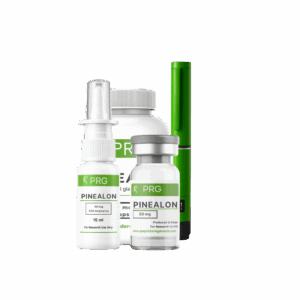
The Pinealon peptide is a synthetic tripeptide composed of glutamic acid, aspartic acid and arginine (Glu-Asp-Arg, or EDR). It belongs to a category of short peptide bioregulators developed by the St. Petersburg Institute of Bioregulation and Gerontology, the same research group behind Epitalon, and is studied primarily in the context of neuroprotection and central nervous system function.
Key identifiers:
- Sequence: Glu-Asp-Arg (E-D-R)
- CAS number: 307950-60-3
- Molecular formula: C17H28N6O8
- Molecular weight: approximately 432.44 g/mol
- Form: lyophilised powder, ≥98% purity typical
Research use only. Pinealon is sold for laboratory research. It is not a medicine, supplement or food, and it is not intended for human or veterinary use.
Pinealon Peptides: The Research Background
Interest in Pinealon peptides grew out of decades of Russian peptide bioregulator research, most notably the work of Vladimir Khavinson’s group, published in journals including Advances in Gerontology and Biogerontology. This body of work examines short peptides derived from or modelled on tissue-specific regulatory sequences, and their effects on gene expression and cellular ageing markers, largely in animal and cell-based models.
It’s worth being precise about what this literature actually establishes. These are mechanistic and preclinical studies; laboratory investigations into cellular signalling, gene expression and oxidative stress markers, not completed human clinical trials measuring cognitive or health outcomes in people. That distinction matters enormously for how any “benefits” language should be interpreted.
Pinealon Peptide Benefits: What the Evidence Actually Supports
Searches for Pinealon peptide benefits are common, and this is exactly where the gap between research and marketing widens. Content circulating online often presents claims like “improves memory,” “may boost serotonin production” or “supports Alzheimer’s” as established outcomes. Reading the primary literature these claims trace back to, the picture looks different:
- Neuroprotection research examines Pinealon’s effect on cultured or animal neural tissue under hypoxic or oxidative stress conditions, not protection in a living person under everyday conditions.
- Cognitive and memory research in this peptide class draws largely from animal behavioural studies (maze performance, for instance), which don’t reliably predict human cognitive outcomes.
- Circadian and mood claims are frequently extrapolated from Pinealon’s proposed mechanism or from findings about related bioregulator peptides, rather than being demonstrated for Pinealon specifically in controlled human studies.
None of this means the underlying research direction isn’t scientifically interesting, short peptide bioregulators are a genuinely active area of gerontology research. But “shields brain cells from hypoxia in a cell model” is a different, much narrower claim than “boosts brain health,” and a page that collapses the two is overstating what’s been shown.
How to Check Supplier Quality
Because Pinealon has no completed human trial data and no approved medicinal status, documentation matters more than marketing language when choosing a supplier:
- Batch-specific COA confirming HPLC purity (≥98% is a reasonable benchmark) and mass spectrometry identity
- Correct sequence and CAS number (Glu-Asp-Arg, CAS 307950-60-3) stated consistently
- Cited primary literature, ideally linked directly to PubMed or journal pages, rather than vague “studies show” language
- Research-only labelling, with no injection protocols, cycling schedules, or age-bracketed dosing content
- UK-based manufacturing and independent third-party testing available on request
Pinealon Peptide Dosage: Why No Protocol Exists
Searches for Pinealon peptide dosage turn up a surprising amount of specific content, age-bracketed regimens, mg-per-day injection amounts, and multi-times-yearly “cycling” schedules. The honest answer is that no completed human trial has established a safe or effective Pinealon dose for any use, and content presenting such a schedule is going well beyond the evidence.
The figures that do exist in the literature come from animal studies (dose-per-animal amounts in specific species) or from unlinked practitioner and biohacking sources, not from controlled human dose-finding research. Converting an animal-model amount into a human daily dose, and building an injection calendar around it, isn’t a scientifically supported exercise, regardless of how confidently it’s presented.
If you’re a researcher working with Pinealon in a cell-culture or animal-model context, your exposure parameters belong to your own study design, informed by the published literature relevant to your specific model, not a generic online “protocol.”
Storage and Handling
- Store lyophilised powder at -20°C, protected from light and moisture
- Once reconstituted, follow the storage guidance specific to your batch and diluent
- Avoid repeated freeze-thaw cycles
- Follow your institution’s validated laboratory procedures for handling and disposal
Supplier Comparison at a Glance
| Factor | Strong supplier | Warning signs |
|---|---|---|
| Testing | Batch COA, HPLC + mass spec | No documentation |
| Literature | Cited, linked primary sources | Vague “studies show” claims |
| Claims | Research framing, mechanism described precisely | “Boosts memory,” “supports Alzheimer’s” stated as fact |
| Content | No dosing information | Age-bracketed mg/day protocols, injection cycling schedules |
| Regulatory framing | Accurate, UK-specific | Vague or absent |
Frequently Asked Questions
Is Pinealon the same as Epitalon?
No. They’re both short peptide bioregulators from the same research tradition, but Pinealon (three amino acids, Glu-Asp-Arg) is studied primarily in neuroprotection contexts, while Epitalon (four amino acids, Ala-Glu-Asp-Gly) is studied mainly in telomere and circadian research. They shouldn’t be treated as interchangeable.
Is there a proven human dose for Pinealon?
No. Available data comes from animal and cell-culture studies. No completed human dose-finding trial has established a dose, schedule or administration route.
Is Pinealon approved as a medicine in the UK?
No. It has no MHRA-approved medicinal status and is sold strictly for laboratory research.
What should I check before buying a research vial?
A batch-specific COA with independent purity and identity testing, a correctly stated sequence and CAS number, and no dosing or “protocol” content on the page.
Final Thoughts
Pinealon sits within a genuinely active area of peptide bioregulator research, but a lot of what’s published online about it, particularly “benefits” and “dosage” content, extrapolates well past what the underlying animal and cell studies actually show. Choose a supplier that represents that gap honestly: cited literature, verified purity, and no invented human protocol.
Reviews
There are no reviews yet.